
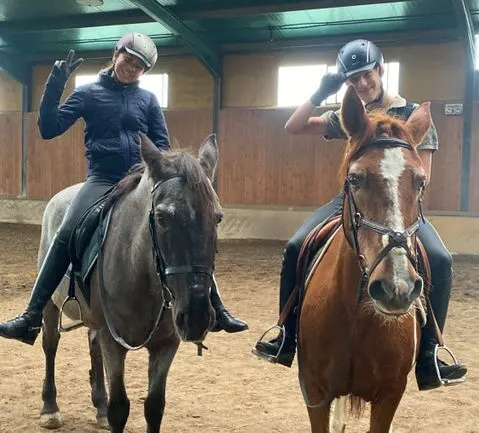
Equine-assisted therapy is a psychological or neuropsychological intervention delivered with the help of a horse, working towards individual clinical goals. Hippotherapy is narrower: it uses the horse's three-dimensional movement as a physical treatment and is delivered by physiotherapists or occupational therapists. Adapted riding is not therapy at all — it is sport, with the adaptations each person needs.
At PSICAB, in Madrid, we deliver equine-assisted therapy: every session is led by a psychologist registered with the Official College of Psychology of Madrid, lasts about 45 minutes, is individual, and has a technician handling the horse throughout. We work with autism, acquired brain injury, developmental delay, attention difficulties and emotional wellbeing, from childhood to adulthood.
Hippotherapy, equine-assisted therapy and adapted riding
These three terms are not synonyms, and the difference matters when you are choosing and paying for a service. It is not about the horse: it is about the goal and about who leads the session.
| Hippotherapy | Equine-assisted therapy (therapeutic riding) |
Adapted riding | |
|---|---|---|---|
| Is it therapy? | Yes | Yes | No: it is sport |
| Main goal | Motor and postural | Cognitive, emotional, social and motor | Learning to ride |
| Who delivers it | Physiotherapist or occupational therapist | Psychologist or neuropsychologist | Riding instructor |
| The person's role | Passive: receives the movement | Active: carries out tasks | Active: learns technique |
| Typical profile | Cerebral palsy, motor impairment | Autism, developmental delay, anxiety, behaviour | Any disability, with an interest in sport |
| Evidence base | The strongest, especially in cerebral palsy | Promising and growing | Not applicable: no clinical claim |
Hippotherapy uses the movement itself as the treatment. At walking pace a horse transmits a three-dimensional movement —forwards and back, up and down, and rotational— very close to human gait. The person does not steer or carry out tasks: they receive that movement and respond to it, while the therapist modulates the effect by changing position, rhythm or route. It is delivered by physiotherapists or occupational therapists with specific training.
Equine-assisted therapy is what we do at PSICAB. Here the horse is not only a source of movement: it is a relational mediator. The person takes part actively —grooming it, leading it, asking things of it, carrying out tasks while mounted— and that activity is the psychologist's working material.
Adapted riding is sport, and that is not a lesser thing: having your own sport and a skill to show is exactly what many people need. It can reach competition level, since para-equestrian is a Paralympic discipline. What it does not have is a clinical treatment plan, so it should not be bought expecting clinical results.
Who we work with
Therapy at PSICAB is built around individual goals, so the diagnosis is never the whole question. These are the profiles we see most often.
Autism (ASD)
Much of the social difficulty in autism comes from how unpredictable human communication is: irony, double meanings, a face that changes mid-sentence, the implicit demand to make eye contact. A horse removes almost all of that layer. Its communication is physical, direct and consistent, the consequence is immediate and always the same, and it carries no reproach. Add the organising effect of rhythmic movement on the sensory system, and a child who refuses to enter a consulting room but asks to go to the stables, and you have the two things clinical work needs: regulation and engagement.
Acquired brain injury and stroke
Rehabilitation after a stroke or a head injury mostly happens in a room, with a table, a screen and repeated exercises. It works and it is essential, but what is trained at a table does not always transfer to real life, and months of repetition are exhausting. The horse adds a real environment —noise, uneven ground, an animal that responds— where attention, executive function and postural control are demanded at once. It complements neurorehabilitation; it never replaces it.
Developmental delay
With global developmental delay and rare conditions, goals are set around everyday function: communication, autonomy, body awareness, following instructions and tolerating change. Progress is recorded session by session and reviewed with the family.
Attention and executive function
On a horse you cannot switch off. Attention has to be sustained, shifted when the environment demands it, and divided between two tasks at once. Planning a route, anticipating what the horse will do and inhibiting an impulsive response all have immediate, real consequences, which a desk exercise cannot reproduce.
Emotional wellbeing
Anxiety, low self-esteem and behavioural difficulties are frequent reasons for coming, in children and in adults alike. Caring for an animal that responds to how you arrive is a direct, unsentimental way to work on regulation.
What a session looks like
A session lasts about 45 minutes, is always individual, and follows the same structure every time: arrival and preview, work with the horse from the ground, mounted work if appropriate, a fixed closing routine and feedback to the family. That predictability is not a detail — for many people it is the condition for being able to work at all. The five steps are set out on our main English page.
Two professionals are present in every therapy session: the registered psychologist who directs the intervention, and a technician who handles the horse and safety. A helmet is compulsory, mounted work is always at walking pace, and the horses are selected and habituated to adapted equipment, unexpected noise and sudden movements.
What the evidence says, and what we do not promise
Research into equine-assisted interventions is promising but still limited. It is strongest in hippotherapy for cerebral palsy, where several trials have shown improvements in gross motor function and postural control. In autism, controlled trials point to improvements in social behaviour, irritability and hyperactivity, with small samples and very different protocols. In cognitive rehabilitation after brain injury, the evidence is thinner than in motor work.
So, plainly: equine therapy does not cure autism, does not replace speech therapy, occupational therapy, physiotherapy or medical follow-up, and cannot promise results or timescales. Anyone who tells you otherwise is telling you more than the evidence supports. What we do offer is written goals, a registered psychologist in charge of every session, and an honest answer at the free assessment.
Sessions are available in English. Just tell us when you get in touch and we will arrange it.
Questions families ask
Is hippotherapy the same as equine therapy?
No. Hippotherapy uses the horse's movement as a physical treatment and is delivered by a physiotherapist or occupational therapist, with the person receiving the movement passively. Equine-assisted therapy is led by a psychologist or neuropsychologist and the person takes part actively, working towards cognitive, emotional, communicative and social goals. PSICAB delivers the second.
Does my child need to know how to ride?
No, and we do not teach riding in therapy sessions. A good part of the work happens on the ground: greeting, grooming and preparing the horse. Some children take weeks before they get on, and some never do and still meet their goals. Nobody is pushed.
How long does a session last and who is present?
About 45 minutes. In equine-assisted therapy there are always two professionals: a registered psychologist who directs the intervention and sets the goals, and an equine therapy technician who handles the horse and safety. Sessions are individual.
Is it safe?
The horse is always led by a technician, mounted work is always at walking pace and a helmet is compulsory. The horses are selected and habituated to adapted equipment, sudden movements and unexpected noise. If conditions do not allow safe work, the session is stopped and rescheduled.
Can it help a child with autism?
It can, and it is the profile we see most. Controlled trials point to improvements in social behaviour, irritability and hyperactivity, although the evidence is still limited. What we offer is written individual goals, a psychologist with postgraduate training in autism leading every session, and an honest answer at the free assessment.
Can adults come after a stroke?
Yes, once the medical situation is stable and there are clear functional goals. It works alongside neurorehabilitation —never instead of it— on attention, executive function, memory and postural control. If your neurologist advises against physical activity, that answer comes before ours.
Related pages
Start with a free assessment
Tell us about your situation and we will tell you honestly whether we can help. No cost, no commitment.