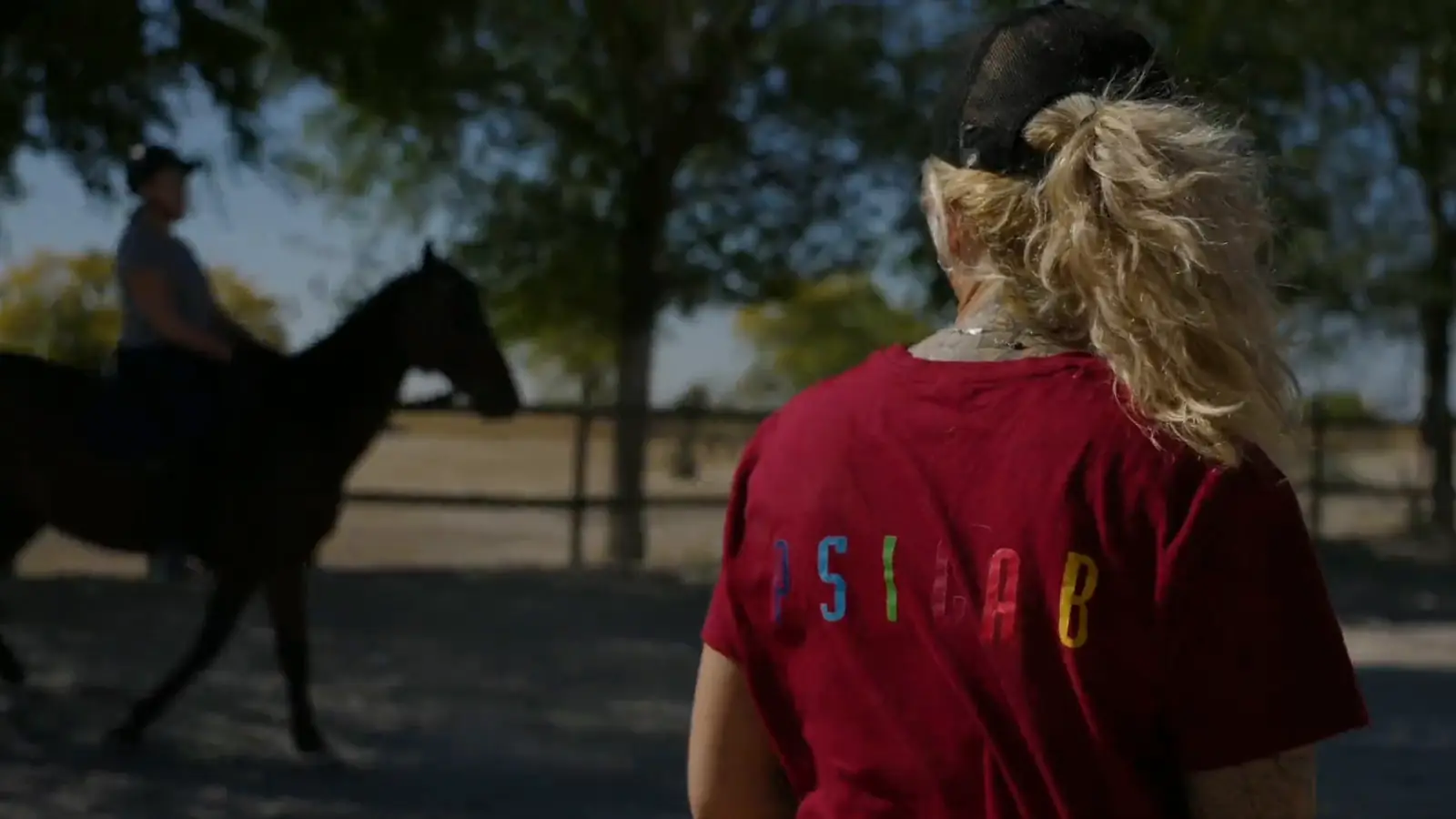
PSICAB is an equine therapy centre in Madrid where psychological and neuropsychological intervention is delivered with the help of horses. Sessions are led by psychologists registered with the Official College of Psychology of Madrid, work towards written individual goals, and are open to children, teenagers and adults.
We are based at Hípica El Molino, Carretera Fuencarral - El Pardo (M-612), km 3.4, 28049 Madrid, a short drive from Alcobendas and northern Madrid. Sessions can be delivered in English. The first assessment is free, there is no registration fee and no minimum commitment. Equine-assisted therapy starts at €175 per month and adapted riding at €135 per month in 2026.
What PSICAB does
PSICAB is an equine therapy centre in Madrid where psychologists use horses as a therapeutic tool. Every session is led by a psychologist or neuropsychologist registered with the Official College of Psychology of Madrid, and every programme starts from written, individual goals rather than from riding lessons.
We work with children, teenagers and adults. The centre is based at Hípica El Molino, in the El Pardo countryside inside Madrid city limits, a 10 to 25 minute drive from most of northern Madrid.
Our three services
There are three ways to work with us, and they are not the same thing. Which one suits you is decided together at the free first assessment, not before.
| Service | What it is | From |
|---|---|---|
| Equine-assisted therapy | Clinical work with therapeutic goals: attention, executive function, memory, emotional regulation, communication and posture. Led by a registered psychologist, with a riding technician handling the horse. | €175 / month |
| Adapted riding | Sport, not therapy: learning to ride with whatever adaptations in equipment, technique and pace a person needs, with therapeutic support alongside. | €135 / month |
| Group programmes | Sessions for schools, associations and organisations, designed around each group's project. | Quote on request |
Therapy and riding are not mutually exclusive, and families often move from one to the other as goals change. The difference between them —and between both and hippotherapy— is explained in detail on hippotherapy and equine therapy.
Who it is for
Equine-assisted therapy suits people whose goals are cognitive, emotional, communicative or behavioural, at any age. In practice, these are the situations families come to us with:
- Children with autism (ASD), where the horse offers communication that is physical, direct and consistent, without the implicit social demands that make human interaction hard work.
- Global developmental delay and rare conditions, with goals set around everyday function.
- Acquired brain injury in adults —after a stroke or a head injury— as a complement to neurorehabilitation, never as a replacement for it.
- Attention and executive-function difficulties, where the horse makes it impossible to switch off and planning has immediate, real consequences.
- Anxiety, low self-esteem and emotional wellbeing, including adults who simply need an hour a week that works.
We also say no. If at the assessment we think equine therapy is not what a person needs right now, we will tell you and point you elsewhere.
The free first assessment
The first visit is an assessment, not a therapy session, and it costs nothing. It takes a little longer than a normal session and does three things: we get to know the case, we see how the person responds to the horse and to an open, outdoor environment, and we tell you honestly whether we believe we can help.
If we go ahead, you leave with proposed goals and a frequency —fortnightly or weekly— and therefore with an exact price. There is no registration fee, no joining fee and no minimum commitment.
How a session works
A session lasts about 45 minutes and always follows the same order, deliberately: for many people, especially with autism, knowing exactly what comes next is what makes it possible to work at all.
- Arrival and preview. What is going to happen, with visual supports if the person uses them.
- Meeting the horse, from the ground. Greeting, grooming, getting it ready. This is therapeutic work in its own right: requesting, waiting, functional eye contact, caring for another.
- Mounted work, if appropriate. Always at walking pace and always led by a technician, with adapted material: circuits, colour sequences, sorting tasks, balance exercises.
- A fixed goodbye routine, which makes the transition out far easier.
- Feedback to the family on what was worked on and what to reinforce at home.
In equine-assisted therapy there are always two professionals present: the psychologist who directs the intervention, and a riding technician responsible for the horse and for safety.
The team
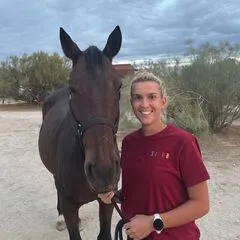
PSICAB is directed by Sofía Calvo Casanova, clinical psychologist and neuropsychologist, registration number M-36125, with a Master's in Clinical Neuropsychology and a postgraduate qualification in autism spectrum disorders. She competed in dressage for ten years.
She works with Noelia Cuerdo de Entrambasaguas, psychologist, registration number M-44959, and with two equine therapy technicians, Carlota Agustín Rodríguez and Sofía Oviedo Romano. Registration numbers are public and can be checked with the Official College of Psychology of Madrid.
And four horses: Cachelo, Carioca, Woody and Perdigón. The horse for each session is chosen on professional criteria, so it is not always the same one.
Where we are
We are at Hípica El Molino, Carretera Fuencarral - El Pardo (M-612), km 3.4, 28049 Madrid, with parking on site. It is open countryside, so it is far better reached by car; almost every family drives.
Driving times and directions are on the contact page, along with the phone number, WhatsApp and the form.
Sessions are available in English. Just tell us when you get in touch and we will arrange it.
Related pages
Start with a free assessment
Tell us what you are looking for and we will tell you honestly whether we can help. No cost, no commitment.